Not Just a Gold at The 1972 Paralymics
- thepadol2
- Sep 18, 2024
- 6 min read

You would not be alone in not knowing or having ever heard of Padma Shri, but while you would be amongst the majority, there are 1,428,627,633 others who know what it is. Merely a different perspective. Officially, Padma Shri, is India's fourth highest civilian award and while some persons do take issue with it, perhaps because they feel they deserve a more prestigious award, it is nonetheless an award at the national level and for a nation of more that 1 billion, statistically there will be many outstanding individuals of all walks of life whose numbers will be much higher than most other countries. But this musing is not about Padma Shri, but how we come to know about the accomplishment of one recipient.
I am most certain that many people in the western hemisphere, will, for all sorts of reasons, thumb their nose at films produced and released by Bollywood rather than Hollywood. Just as in Hollywood and other productions, many films are made with the goal of some degree of commercial success, and therefore must in some way be entertaining to the audience. The same is equally true of Bollywood. So, yes, there are many films that maybe I wouldn't watch because they're not my genre, or maybe more of a B type film, in the vast offerings there are still a multitude of productions that deserve a viewing, enjoyment, and why not - learn something.
Bollywood does have one niche that provides a portfolio of extremely entertaining productions while at the same time capable of a very strong messaging. These are films that bring to large screen the stories of individuals who have achieved success while overcoming overwhelming obstacles, and they are based on true events. You could say that this isn't particularly unique in the film industry, but I think otherwise. Hollywood and Indie makers due bring to the screen the stories of success by individual, but by and large they are centered on well known names, in some way celebrities who have existed. Bollywood is different because many of the stories are of individuals who have limited name recognition and for some maybe even forgotten with the passing of time.
"Chandu Champion" is one of the more recent one. It is the story of Murlikant Petkar. The story begins with Murlikant Petkar as an aged elderly with crutches who comes to a police station to lodge a complaint against the President of India for not being awarded the Arujana award for his achievements. Clearly the attending police officer and others think that it is all a joke since what can an elderly disabled person possibly be able to do. For a better explanation Murlikant recounts his incredible journey.
As a young boy in 1952, in one of India's infinite small villages, he learns of the Olympic Games and develops an ambition to win a gold medal for India. India is a young nation at the time having only gained its independence in 1947. It is an ambition he is mocked for and the chant of other boys "Chandu Champion" is loosely translated as Loser Champion. He chooses to train himself as a wrestler as that is the only sport he is familiar with and that the village has people who train for it. It is not easy and he is only accepted because of his persistence and stubbornness, although it is difficult to know if he would ever develop the strength and attitude. Events contrive that he actually wins a match that should have been lost to the son of a local politician, and this upset causes him to flee the village.
He manages to escape his pursuiters with the help of Karnail Singh who gives him a hand to get on a moving train. While at first Karnail too scoffs at Murlì's ambition, he suggests that Murli come with him to join the Indian army corps of engineers, EME, because in time he might be selected to be a boxer. Indeed all goes well with Murli switching from wrestling to boxing. He represents India at the 1964 Tokyo event.. but it doesn't end well as Murli gets distracted. It is a let down and his coach doesn't think he deserves a second chance.
Some years later, in 1965, his unit is involved in the India Pakistan war, and while saving his coach's life, he loses his only friend Karnail, and he himself is severely injured by nine bullets. One bullet remains lodged close to his spine and he remains a paraplegic. His dreams and hopes of the future are shattered and life is meaningless.
His coach visits Murli, thanking him for saving his life. He convinces Murli that as a paraplegic, there are ways he could compete, and the one that seems suitable for him is swimming. He trains and trains. He meets the selection critieria but India's Olymipic committee has limited funds as India is fighting Pakistan. In the end, the committee comes around to acknowledge that Murli's bravery in the India Pakistan war is best recognized by him honoring India at the Olympics.
But it is 1972 and the Munich Olympics is home to tragedy and horror of the terrorist attack. Murli's paralympic event takes place at the venue at Heidelberg, in the shadows of the general Olympics and the tragedy. There in 1972 Murli makes history by winning the gold medal in the 50m freestyle. It is India's first individual gold medal.
Murli returns to his village and is welcomed as a hero.

Bollywood films don't have to conform to the run lengths typical of Hollywood and this gives them an opportunity to develop storytelling in a more complete and flexible way. Chandu Champion is no exception. The pace is neither hurried or overbearing. At a run length of 142 minutes, and not having any idea of Murli's journey, at 80 minutes one could even think that the conclusion is near while it is just mid-way and gearing up into the heart of his journey. Many Hollywood biopics, hampered by the run length, resort to focusing on certain time periods rather than being biographical in nature. Two fine examples come to mind: Invincible with Mark Wahlberg, and the more recent Unsung Heroes.
India is a large and diverse country, and Murli's achievements was not hailed by the country in a media fever or extensive front page coverage. In time they simply became part of a forgotten history.
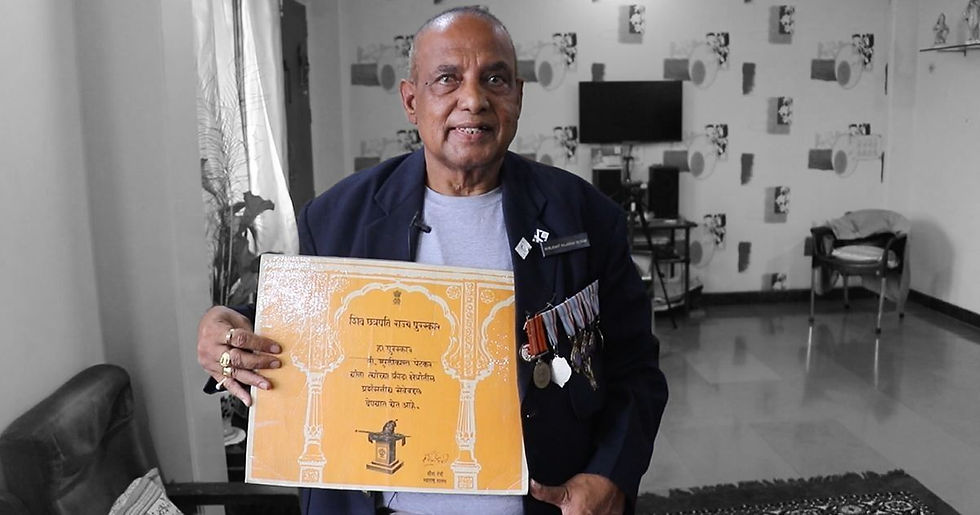
To the police inspector this was an incredible yarn, but he couldn't tell if it was actually true, so he enlisted the help of a journalist to dig into the facts. This started a chain of events where even the Indian army itself was fortunate to find that paper files from Murli's era to not only confirm his journey and singular achievements, but that the army did not recognize them properly. Once the government was apprised, the final cogs went into place.
A senior government official comes to Murli's village, almost 50 years after the achievements, to meet and inform him that the government will not give him the Arjun medal, but the Padma Sri in light of the important achievements.
On 20 March 2018 Murli was presented the Padma Sri by the President of India.

Chandu Champion is when storytelling and its transposition to film is seamless and just enjoyable. Something you would want to get a bucket of popcorn but where every single kernel is enjoyed for its lightness rather than gobbling handfuls as you would for an action sequence. It can and it will pull at the heart all the way.
While the outcome you might predict, how you get there isn't so straightforward. It is inspirational. How adversity is overcomed. How life's journey is full of ups and downs. Be bullied and mocked but an ambition can provide the strength and light.
Ask yourself why you are not watching Bollywood productions? For most, an immediate answer could be that availability is limited, and that's probably a reasonable answer for those who see films through the traditional channels. But, if availability were not so limited, would you be watching? I think it takes time to better understand the genres that Bollywood produces and to see what suits your interests. The paradigm is somewhat different. Indeed even the definition of each genre shifts and changes.
Streaming has provided a number of platforms that offer a good access to Bollywood productions. The more important ones screen the films in original language, say Hindi, but with English subtitles. This is the best way to see them because the acting with Hindi is as intended and the subtitle give you a way to enjoy in parallel. If you have no idea where to start, try - https://einthusan.tv/intro/
You could be hooked. You could binge. Maybe even more than Netflix or Hulu. Maybe you won't have anyone to share it with, but you could certainly smile as you find yourself captured by an entirely unexpected imagination. Might you learn even a bit of Hindi after a while? Maybe. A cultural eye opener? Hopefully.
Namaste.


Comments