A Thousand Words

They say a picture is worth a thousand words, and some hold meanings that are beyond what the picture captures in the moment.
Taken on November 7, 2025, on a late afternoon as the sun is waning in Bangkok, it is a window to a tale of life, of things we never forget, part of our identity, maybe known and understood by few. Anyone who simply looks at the picture merely sees a person enjoying a simple sandwich. Why is it worth a picture? A picture captures an instant of time, impossible to forget, and forever a witness. The tale behind the picture is what sets it apart and becomes a legacy, one for future generations of the family to know and cherish.
My brother here, Sivaporn, is what the Italians would call un miracolato, which probably doesn't need to be translated. After four months in the ICU, in a semi-comatose state for weeks, battling the ravages of septic shock, he was able to continue recovery at home with specialized home care round the clock. After ten months, literally a year, this is the progress he has made. By all accounts, most people who are already suffering from other ailments and have a compromised cardiovascular system, the outcome from sepsis gives little hope; the numbers don't lie. So somewhere between a bit of luck, a hint of a small miracle, and a spirit that never gives up, a chance with life? Who knows, but for the moment, it's time to enjoy something that is special.
Special it is to the beholder. Not all bread is created equally. Today that means all sorts of boutique-like creations, bakeries that have become experimental laboratories, and prices to go along. But here, we go back in time, to another era, seventy years ago in Rome. A time when Italy was emerging from the suffering of WWII, when bread was made from sawdust, and bakers could finally make bread worthy of being called bread. Bakers were everywhere, part of the neighborhood daily grocery necessities. It was hard work with the earliest of hours and the continued preparation for the following day's yeast. No one complained. It was a respectable profession. Notably though, bakers did not provide variety, just what was considered to be bread of the time. Household bread depended on the work the men had, be it manual or skilled labor, and therefore the need for a heartier type of bread. Bread, then and now, was sold by weight, never by pieces or slices. Each region and even provinces had their own "speciality," not because of market demand, but because that is what the local baker knew how to make and the flour found locally was a good fit. The other element was the art or baker's touch. While still true today, at the time all the ovens were wood-fired, meaning an incredible challenge to deal with uneven conditions, whether temperature, moisture, to name a few. So a rosetta, ciriola, panino ad olio, amongst the most popular, came in all sorts of sizes and differences, much like for coffee in Italy, it is never just caffe, everyone has a preference, lungo, corto, macchiato, and any other imaginable combination.
The distinctive rosetta, beloved by all, could be crisp on the outside, crunchy, biscuit-like, dry, and the inside, well, traditionally relatively hollow, but it could also be full to varying degrees. Some are well-formed, others less so. Any proper housewife buying them would demand the kind they wanted, and the baker had better be careful lest they get an earful the following day, maybe getting a rosetta thrown at them.
Left to Right - Rosetta, Ciriola, Panino ad olio
Every time I come to Bangkok from Rome, bags of rosette are part of the trip. I place an order with the baker since these days bakers make all types of bread, which reduces the volume of rosetta baked for the day. For my brother, my nephew and niece, and now the grandkids, I suppose I would have to bring two suitcases full of rosette, not really manageable unless you have space and weight to spare. Still, I managed twenty this time. Sivaporn promptly placed them in the freezer while a bag he reserved as an immediate treat. Not only can you not find them in Bangkok, but nowhere else in the world. Making rosetta is an art beyond the recipe, which in itself is complex and time-consuming.
But what would a rosetta be by itself? I guarantee you that a freshly baked rosetta that is still very warm has that unmistakable fragrance, and you had better buy two rather than one since it's impossible not to try it—I mean devour it. A panino, a sandwich, is a creation these days; in the past, it meant a very basic meal. Prosciutto, salame, and mortadella were the traditional deli meats. Just consider salame, not salami as some like to call it improperly; again, a varied choice, and seventy years ago, very much dependent on the local availability. The salame, too, is just not any that you can find. This is an Italian salame tipo "Milano" which can be found in any Italian supermarket, but this one is from a specific deli that has remained true to its supplier over the years. Yes, "Milano" salame is sold everywhere, but every producer tastes different. Some are very salty. Some have a bitter taste. Some are greasy. Some leave a dry sensation in the mouth. It's endless. This is the way we like it and I have sourced it from the same place for the past thirty years. An entire salame, actually two, weighing over two kilos, was brought from Rome to Bangkok, to be sliced fresh when needed.

Sivaporn, like many growing up in Rome, found focaccia pizza bread and mortadella to be a classic, although more of a mid-morning delicacy. This classic with the rosetta, was more the golden standard for consumption at any time of the day.

What you eat and what you like varies and evolves over the years. Palates are acquired with the myriad of things we taste and try. Nonetheless, some are part of our childhood as the first tastes and remain indelible forever. As in the animation "Ratatouille," a taste like this brings back instant memories that, while distant in time, feel like just now. The meaning of the taste goes well beyond the memories; it is associated with how we grew up, with our identity, who we are, why we are who we are, ultimately defining the emotions that have been part of our life's choices and the paths we've taken.
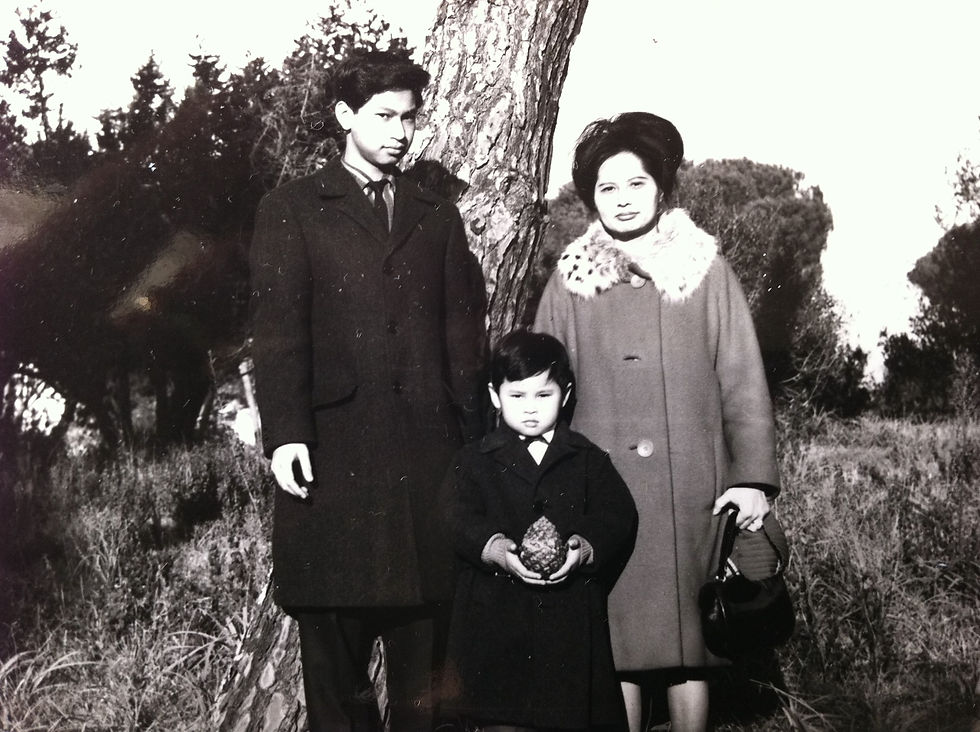
A younger version of Sivaporn, and yours truly as the kid brother, together with Mom on an outing in the area of La Pineta, Rome's coastal pine tree grounds. That's the simple picture. The tale is that we are all fond of the rosetta, and he and I know exactly what a rosetta with salame Milano represents. It is also a memory of Mom. As kids, it was always Mom who went grocery shopping, every day, fresh rosette, and the day's salame. Later, when we had a refrigerator, maybe the salame was no longer a daily purchase, but rosette, yes.
Memories of a taste and fragrance, time passes but some things are unforgettable and a constant yearning.


You made me hungry!