Leaving on a Jet Plane
- thepadol2
- Dec 19, 2023
- 14 min read

1964
These days flying feels more like a nuisance rather than something magical and to be treated like a surprise experience. Getting to the airport hours before departure, joining the check-in queue (the first of many lines), or fight with a self-service kiosk as it gives undecipherable instruction on how to tag your bags, constantly looking at your id docs, and much more during COVID, to make sure you have everything, looking for the shortest or quickest security line, getting through passport check, and finally trying to find a place to sit at the boarding gate if you aren't privileged with a lounge. Pay thru the roof for plain simple water, in some places more expensive than gasoline itself. You get the picture.
By the time I was flying regularly, I was a.young adult at the tail end of what is typically known as the golden age of flying, but there was a time, as a child, that flying with my folks was filled with anticipation, and it simply meant Bangkok was awaiting, a far far away place from Rome.
FCO
The earliest memory I have on flying wasn't the flying itself, but seeing my brother off as he left for college. I was just six at the time and had no idea of the significance. The airport was Rome's recently opened new airport, Leonardo da Vinci or Fiumicino as it is informally known for the nearby seaside city where it's located. Indeed you would think that the airport code would be something like LDV or RLV for it's official name, Leonardo da Vinci, but instead it's FCO for Fiumicino. The airport terminal was imposing both outside and inside, but also because flying was still a privilege although it had become more accessible. Jet flying had just been introduced a decade earlier. I remember we said our goodbyes before he went through passport check. It was the first time I observed a ritual that would repeat itself many times in the future - the notion of being on one side rather than the other and that there was always this passport control point to denote the boundary. These days this point has been extended to the security point while in reality that separation is due to the need to maintain a distinction in jurisdiciton for area considered extra territorial. We did make our way to an observation area that was literally part of the departure area and my brother's plane felt like it was within reach. Over the years, the acronym FAO became a simple trigger of FCO=home whether coming or going.
Working for the Food and Agriculture Organization (FAO), an agency of the United Nations located in Rome, Dad was entitled to a home leave every two years which he obviously used as the entire family was covered. Since he joined, home leave fell on odd years. My memories, at least the ones more than just a sensation, only start around 1964, meaning that while I would have traveled on home leave in 1959, 1961, 1963, 1965, 1967, 1969, (subsequent years are modern day jets), only the latter four would be part of the flying for which I have any direct recollection.
As a child the fact that flying was special was beyond my comprehension. I was already among the few fortunates that were already in the air at such a young age. We were still in a time when folks who went on home leave to the US actually didn't fly but took to the sea on a transatlantic ocean liner. That wasn't going to happen going to Bangkok from Rome.
To me flying wasn't flying to go somewhere, it was part and parcel of how home leave happened. Dad was always a meticulous planner and never did anything last minute, actually well in advance that what was really needed. His watch was always on time, his time that is - he would have it set 10 minutes ahead of the actual hour. It was his way of making sure of being punctual with enough lead time. I'm sure that there were times when people may have just looked at the time of his watch and then panicked thinking that there were late for wherever they were going. Some may have figured it out, but I doubt it since 10 mins wasn't such a great variance in age of mechanical timepieces.
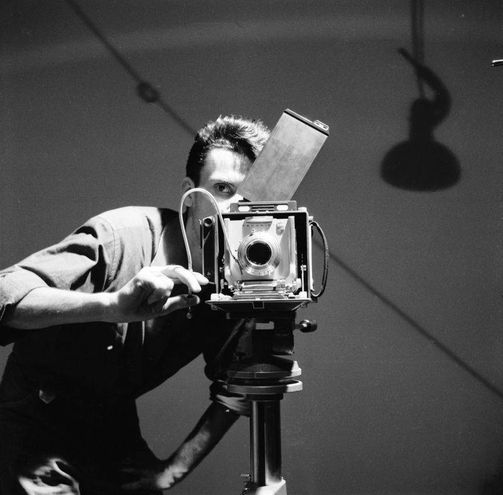
Studio and Photographer
As with other things, when you need to do something there are probably a thousand things that need to be done first. The first order of business was having photos, what today would considered ID or passport photos. There were no self service kiosk photo booths. You actually had to go to a photographer's studio to have it done. Get an appointment as this wasn't a walk-in request. Luckily there was a studio near home. Just taking this picture was huge affair. While it was in black and white, you had to be dressed properly and appropriately groomed. That meant a coat and tie for me. Probably uncomfortable for the time involved as it took several hours to go through the seating. Dad wasn't too fussy as he was already with a coat and tie as the office attire. Mom instead was a different story altogether. A picture was being taken and she wasn't going to be imortalized looking mundane. There was the trip to the hairdresser, the choice of dress that would render well in black and white, and the infinite time on getting the makeup picture perfect. So, even if the session with the photographer was early evening, it all started quite early on, the morning of that day. As a child my picture was with Mom and then later I had my own passport. The studio wasn't on the ground and so we had to navigate the narrow stairs up to a room that for me was completely alien with all the lighting equipment and black drapes. Could have felt like going to an imagined torture chamber but seeing that I was with parents that dread quickly passed. Did I have the patience to sit still and not squint my eyes at the flash? Who knows. Then it was like another week before we actually got the prints or rather we saw the test of the prints to see if they were fine. Maybe Dad and mine were ok but Mom perhaps didn't like her smile and wanted it re-taken. So maybe a month goes by before the sets are ready. Probably an expensive exercise too seeing how many rolls of film and development it took.

Passports
Next step was getting the new passports. Don't know why but it seems the passports didn't have a long validity as getting new pictures taken seem to happen every other year. There were very few Thai people in Italy at the time and for the most part were part of the embassy as diplomats. This meant that passport processing wasn't a regular affair and international travel still had some adventurous connotation. Everything was done by hand, no barcodes or QR codes, no databases, no strict rules or procedures. Maybe that was an advantage though. Issuing passports wasn't a centralized activity, for logistical reasons it was delegated to the embassy following a set of procedures. Gives you a sense of the uniqueness when a relatively small country is involved. Not being part of the Thai embassy, Mom and Dad would embark on the task of seeing the right embassy staff person to handle the need. They would try to meet with the Third or Second Secretary to be as discreet as possible and to avoid giving the impression of asking for a favor. When the time came, getting into the embassy for the meeting seemed almost like a spy movie, the sort of tiptoing around, blending in, or for quick in and out. Whoever it was we went to see, pleasnatries were exchange both in conversation as well as token of gifts - much like not going empty handed to an invite. I never sensed there would be a problem, it seemed more like a formality. In those days there were no set standards for picture sizes or how the subject was to be taken. It wasn't hit or miss, but the embassy person didn't have an instruction book to follow. So there was quite a bit of discussion on which picture to use from among the set, if the scissors would crop it approrpiately. Essentially the passport was another official embassy document and so the markings and stamps, embossed or not, were all part of the ritual. None could be done in 5 minutes as they already different levels of sign offs. So another trip was to return to pick the new passports up.
You could say that passports held a special regard as they were treated with white gloves. Even more so when their officiality was thru the Rome Embassy and therefore in no way could they be replaced elsewhere although I'm sure with the appropriate calls to the right parties a solution could be found. Better to avoid.
Tickets
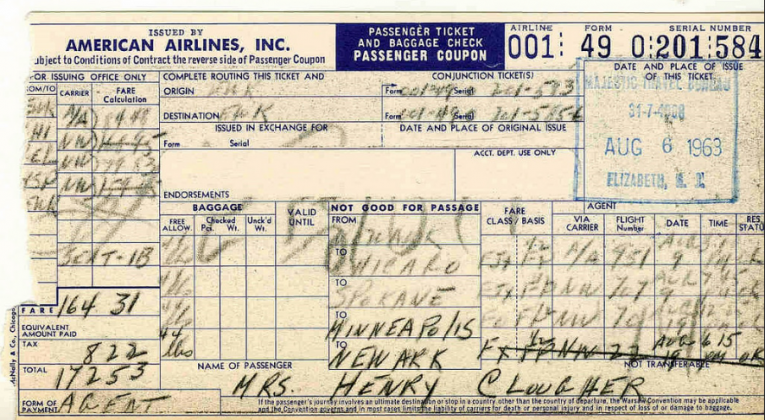
You don't get on plane without a plane ticket. A real paper ticket. The plane ticket would hold a particular fascination for me for many years. It was an odd sized document and held that special "technological" sophistication as it was small print, multiple carbon copies, perforated to facilitate removal, and of course with the nice airline logo on the cover. It had strange codes and writing all over that were simply mysteries waiting to be solved.But the critical parts of the ticket had to painstakenly written in by the travel agent and it had to have the right information otherwise it meant trouble at checkin, whether on the outbound or inbound leg, or anywhere in between for that matter. Getting the plane tickets were another saga onto themselves.

Today you get on the internet on booking site, look up the itinerary and dates you want, put in some criteria, get a selection of offering, decide based on fare or other requirements, make up your mind to pay within a time limit of few minutes, and if payment goes thru, voilà, electronic ticket is issued to you. If you made a mistake tough luck. Those days it was more like request, reserve as in booking, confirm, issue, pay. It had to be done thru a travel agent or airline sales rep at their office.

Dad would go to the travel agency located with the FAO building and put in a request for home leave with itinerary and dates. The airlines would publish their timetable volumes for travel agents to use. In those days Rome was a real major destination as well as a key gateway for Europe. Major airlines also used it as a waypoint in order to cover distances. Getting from Rome to Bangkok would have been a major challenge except that Bangkok too was key gateway and waypoint in the Far East, going to Hong Kong, Japan, and Australia. So from a routing perspectives the travel agent, in theory, didn't have a headache, but the process wasn't so simple. Even if the timetables showed possible routing and schedules, it wasn't the bible as airline adjusted their operation if conditions changed. Hence a request and a booking awaiting confirmation. In some cases the travel agent could phone an airline rep and obtain updated info, but most of the time the request had to get to the airline back office to validate the request and get the booking into the "system" whatever that was in those days. Eventually the booking would be confirmed or modified accordingly. Not a matter of days but more like weeks. Issuing the tickets for the entire family was a laborious affair for the travel agent once they were authorized by the airline to do so. They had to have the right blank tickets - airline logo and the one with the right number of copies depending on routing. While there were no direct flights between Rome and Bangkok, it was generally one flight number making multiple stops. We flew BOAC, Lufthansa, Qantas, and maybe KLM. It had to be airlines who had global coverage. Whichever one it was, getting from Rome to Bangkok necessitated one if not two waypoints for refueling.
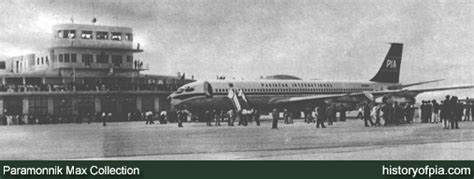
I would always remember if we stopped in Karachi or Bombay as they were known at the time. Once we landed and the cabin door open the air that enter and permeated were unmistakebly Indian for the heat, humidity, and distinct odor. As a kid it was overwhelming and while it's not nice to say, any time I see someone who might be from the Indian continent, the memories of the odor and air magically materialize. Almost like a Pavlov reaction. It wasn't a long stop as it was just technical. Maybe 45 minutes to refuel and then we were on our way again.
Security
I do recall one time we had a routing that put us through Tel Aviv and the Israeli were well advance in their security protocols. We all had to disembark as transit passengers even if it was a short technical stop. Not only, there was a security check to enter the transit area. Dad at the time was still a smoker although he wanted to stop or at least curb the habit. To smoke less he invented a technique which was to cut his cigarettes in half - guess smoke the same number of times but it would just be half in impact. So he had his packs of cigarettes with half size cigarettes in his, office case. Israeli security was not a formality, they really searched and looked for inconsistencies and suspicious things. Imagine when they came upon the cigarettes. I thought we were a goner at that point and began to imagine them tearing shoes apart. I guess they figured he was harmless enough, maybe a little strange. Don't mess with Israeli security probably was the message I learned.
What You Take with You

Home leave also meant we were entitled to excess weight for baggage. And boy was that really put to use. Packing suitcases was a month long ritual at best. The living room space was requisitioned for the purpose. The largest suitcase in those days was maybe half of today's unless you decided to use a trunk but that couldn't be checked as baggage, so more suitcases were used. We typically had a total of eight suitcases. One would be Mom's. When I had my own passport I began to use up space on one and the rest were all Dad's. All tables and chairs would be used to hold the suitcases as Dad would begin to pack them, slowly, ever day for the month. To my recollection we didn't have a weighing scale so I think we just did it by feel in the hope it would all be fine. As I would say many many years later - at the time as a kid I really thought Dad was strange with so many suitcases and why couldn't we be more normal - and today I'm doing exactly what he did by using 4 large suitcases for two people and purchasing excess in advance to cover the additional need.
A well known fact of the golden era of flying was that you would look your best. By the time I could, time would be spent deciding on the outfit for the trip. It had to be the best of what I had, probably even a tie to complete. But being in Italy shoes were the fashionable item. The shoe shop was always a constant sight as a kid with growing feet. So it became new shoes for the trip. Who cared if it made you uncomfortable for such a long trip, it was part of the look.
Taxi Taxi
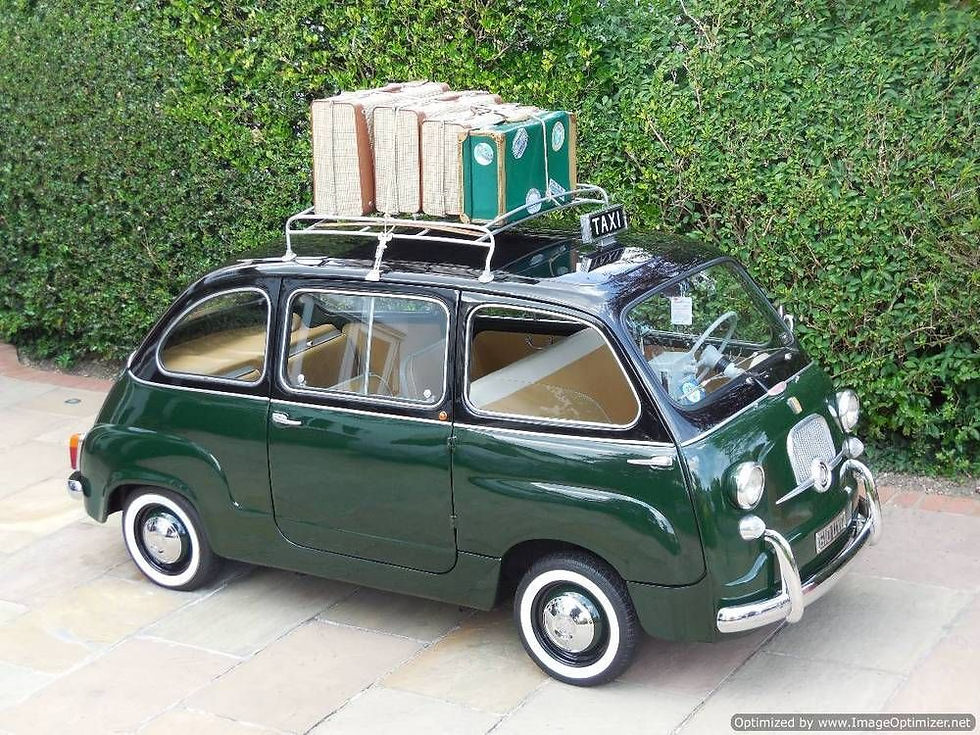
Getting to the airport on the day of departure was another well rehearsed ritual. Getting 8 suitcases, two adults, and child was no simple matter. You would think that it would be impossible to have a simple solution in Rome. Probably true today, but at the time there were taxis that were the FIAT 600 Multipla. In size you it might conjure up the idea of a microvan but that would have been far from the truth. Cars then didn't have to meet crash standards we have today so the inside dimensions pretty corresponded to the exterior size. Today the thickness of doors and other areas for crash requirements mean that cars are really much larger in overall external size while the insides haven't changed much. You could actually fit 8 people in a 600 Multipla, driver not included. The back bench was large enough for three, then there was rear facing folding bench that could fit another three, and then two could go upg front. These taxis also had a roof rack for additional luggage. It could easily fit us and the 8 suitcases in every nook and cranny. It certainly made the Multipla heavy but the taxi driver still tried to achieve breakneck speed which would inevitably elicit a prompt request by Mom to slow down. Mom always won any discussion she got into with any Italian, but I won't go into why. More than once over the years I would recall the taxi drivers to give in to Mom by simply saying "chi va piano va sano e lontano" - he who goes slow goes safe and far. End of discussion. Mind you that the Multipla top speed was probably 60 kph in the best of conditions and unburden by weight.
On a Plane
In those years we were already on jets but they were either a DC-8 or 707. Pressurization wasn't what it is today and those early jets were truly loud The vibrations were equally strong and a constant reminder that you were on a mechanical machine. Being a kid I had no idea of Bernoulli's principle, to me it was just the thrust of the engines that made us fly. Not completely wrong but incomplete. While my folks probably had moments of fear when we rumbled down the runaway for me it was just the prelude to the magic of rising up into the air. No movies, no games, no radio, no ipad, no phones, but I simply don't recall what took up my attention. Somehow the time passed or as one say, it flew by. I suppose the aluminum folding tray was enough to hold my attention. I was always a picky eater and would generally refuse anything remotely unfamiliar in looks, not even in taste. Breakfast on the trip was always high point. Scrambled eggs and bacon was fairly common and I considered that to be a treat. These days it tends to be a spinach omelet and I don't care for the spinach. Instead of bacon it's a chicken sausage, really cheap.
Flying economy wasn't the best but it got the job done. For a kid, space in economy was just not a problem. Drinks and caviar would have been useless for me. Even lobster thermidor wouldn't have impressed me as seafood wasn't on my list of palatable food. Trolleys were unknown at the time. Just a travel tote bag which I didn't have but Mom did and used.

This particular period traveling as a child at the time felt quiite unremarkable for the time on the plane itself. I hadn't been on train. I really hadn't been on bus other than a school bus. I really had no notion of public transportation. It was just the airport that felt different from other experiences, but once on the plane it was like disappearing into a container where the only thing you could do was basically sit. The seat belt (cars didn't have them at the time) and the folding tray were the unique things that reminded me of being on plane. A technological innovation were the headphones that were like stethoscopes, made of plastic, and you had to actually rent them initially. That we were actually in the air and traveling quite fast was beyond my comprehension of the significance.
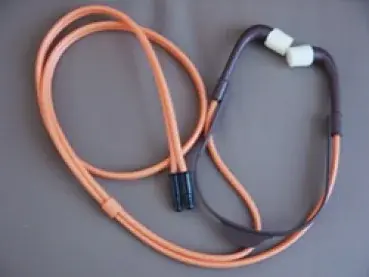
After 1970 things changed rapidly as flying was transformed by so many aspects and factors. Airports became more crowded. The jet planes grew larger as the jumbo came along. Business class was introduced and they were smaller than today's premium economy offering in relative terms. Visas and other immigration requirements became more explicit and regulated. The most visible cue were the lines that go longer and slower. Still, flying was almost a hop on hop off experience for me.
Every now and then a flight would be memorable for some trivial matter. As a college student I was flying Rome - New York twice a year and ran into all sorts of interesting times, not least of which was due to the typical and unpredictable Italian strikes. Once in the early 80s traveling back to Rome, I ended up spending the night at a hotel at JFK as the flight had to be rescheduled for the following day. On the day of departure there was a further delay due to scheduling problems of available aircraft and crew. TWA at the time was flying Boeing 747, probably 100 or 200 variants. This time we got assigned a Boeing 747SP which is the "Special Performance" variant and when we boarded the crew was pretty excited, apparently TWA had just taken delivery and this one of the first initial flights. The plane itself is quite distinctive in how it differs externally from other 747s. The flight was memorable for the simple reason that when the captain announced we had reached cruising altitude it was 38,000 feet, significantly higher than other flights, even to this day. I don't remember the speed but it must have been damn fast since we got to Rome before I had a chance to settle in and be bored. It was like under 6 hours. Kind of felt like being in a Ford GT40 rather than an everyday Chevy.


Comments