Eating Italian (But Not The Way You Think)
- thepadol2
- Jun 25, 2024
- 17 min read

Say "cafeteria" and most people have an immediate picture in their mind or at least some gut reaction, and typically it's somewhere between being indifferent to recalling some negative experience. Most of it has to do with the early association of a cafeteria as the place for school meals. As with other things, mileage varies.
A school cafeteria is a child's first experience of eating away from home, with a different meal variety, and most notably a situation where you either eat what is served or go hungry. It's not a difficult choice to make.
Over the years, I've eaten in several types of cafeterias, whether by choice or because it was the easiest option, but what I've experienced in Italy is worthy of a few words. "Mensa" is Italian for cafeteria or refectory. Stick with me down this memory lane and maybe in the end, you will smile knowing that "mensa" is and isn't a cafeteria, just like a Ferrari is a car and not just a car. While a Tesla might represent a new standard, it remains outclassed by a Ferrari 12Cilindri and its heritage.

From the 60s to the 80s, Italy was full of "Tavola Calda," meaning literally a hot table, and then inexorably they disappeared, making way for kebabs, sushi bars, poke bowls, and other forms of fast food. The "Tavola Calda" was actually an evolution from the company cafeterias to the general public by making it affordable to eat out with the combination of self-service, as restaurants with sit-down service were still relatively inaccessible to the majority of Italians. Trattorias and Osterias were far and few between with limited offerings and varied quite a bit in quality. A "Tavola Calda," while not really creative in their offerings, did, however, have a consistent range of variety that worked for families. Those growing up in those years have fond memories of these neighborhood"Tavola Calda," and the Pavesi places on the Autostrada between Rome and Milan were another example.
In the Very Beginning

My very first experience was in kindergarten with what was simply a cooked meal by the Sisters running the school. Up until then, I had only eaten at home, and quite honestly, I have no clue as to what kind of food I actually ate at the time. At best, by inference, I was picky, and Mom didn't try to discipline me in any way; I suppose she just kind of went along with what kept me happy. As I grew older, it was clear to me that the cuisine in our household was rather odd for many reasons. As a Thai, my folks were rooted in what you can imagine with today's popularity with Thai offerings, but at the time, and in Rome, cooking Thai was not particularly easy, if possible at all, as many ingredients were lacking. However, Mom was quite creative and had a practical palate to figure out what ingredients could be possible alternatives if one didn't have too many expectations. The challenge, though, was that Mom really had three kitchens to work with: one for me and the hours a child eats, what Dad would fancy or be happy with, and whatever Mom wanted to try. So I ended up with a relatively simple palate for bland or salty dishes, no spices, no greens of sorts, and probably a good assortment of carbs and proteins based on rice, pasta, meat, pork, and poultry. French fries were not yet fashionable, actually unheard of in Italy at the time.
The first meal at the Sisters was striking and remains one of the clearest moments there. It was simply a bowl of short pasta, buttered, and with a heavy dose of cheese, mostly melted, and most importantly, you could have caught the aroma a mile away as it made your mouth water uncontrollably. It was probably pasta "ai quattro formaggi" but I had no idea. I must have gulped it down in the blink of an eye. Come to think of it, it was probably the reason I never looked back on going to kindergarten every day, a heavenly meal awaited me every day. I know that it was the first time I made a strong association with the idea of eating "Italian" as it must have been quite a different taste from what I was having at home. Perhaps Mom was worried that I might not like what was served, but I guess that quickly passed.

The Early Years
Next came the time from first to third grade when I was with the Sisters running St. Francis International. Besides being my first challenge in learning english as a new language, the Sisters ran a tight ship. Now lunch was a more structured experience. Not only were the Sisters adamant, more like strict, that everyone ate everything that was served. Each meal in their eyes was one with a balanced goodness, including vegetables, and the greens were something I never liked, an outright refusal. What to do? I tried leaving them on the plates, but I guess some punishment was meted out. It was psychological warfare with physical ramifications. Try as I would, I just couldn't get the greens down my throat without an overwhelming sensation to throw up. It certainly turned lunch into an ordeal. So I came up with a sleight of hand to make the greens disappear from the plate while safeguarding my stomach. I literally hid the greens in the pockets of my pants. It wasn't the greatest of feelings to have something soggy against your leg, but this was better than trying to digest it. It must have worked for a while until the Sisters caught on. Mom must have found it entertaining as she was the one doing the laundry. She certainly wasn't the one to tell the Sisters. They probably told her at a parents' meeting, and I can just imagine her feigning surprise while passing it off as innocent mischief.

The one dish that is well impressed in my memory is something that would be unheard of today for an elementary school. It was a nice piece of beef tenderloin cooked as a prime roast with a sort of Barolo-based sauce. Talk about being fancy. The slices and gravy were served over a serving of piping hot white rice and vegetables. Over the years, I've tried to recreate the taste, but I can never seem to find the right combination. One of those longings.
The Teen Years
For the next eight years, all the way through high school at Notre Dame International School in Rome, lunch was at the school's cafeteria, and during those years, the cafeteria team was pretty much unchanged. The range and variety of the menu were also pretty similar throughout the time. Just as the school was unique due to its scope, location, and students, the cafeteria had its own peculiarities, but as a student at the time, I was pretty oblivious. An Italian kitchen staff provided dishes that had Italian roots, but perhaps in some cases provided fare closer to US expat expectations. It was easy to tell when something was good and found favor; there was always a rush to get seconds. While pasta was on the menu, spaghetti with meatballs was a real treat. Little did I know that such a thing was only a regional specialty and over time would become even harder to find anywhere as it wasn't considered a classic.

A Quick Demo of a Real "Mensa"
While school lunch at NDI was in the cafeteria, it probably was somewhat different from what was the "mensa" at in Italian schools. Something I never got to experience. In those years, however, I had the chance to experience two other mense that little did I know would be a glimpse of my future. The first was having lunch at the FAO mensa. This was really something unusual, perhaps even unexpected. While Dad worked at FAO in Rome for over 25 years, home was pretty close by, so he was home for lunch every day. The reason or occasion I no longer remember, but whatever it was, Mom had me there, maybe on an odd Saturday with some work event that Dad had to participate in. As a picky eater, Mom chose a hard-to-go-wrong choice - lasagna al forno (or maybe it was a timballo al forno). What a treat! As classic of a taste that defines lasagna in the Rome area - slightly burnt crunchy top, a smooth bechamel sauce that was in all the layers well mixed in with the ragù sauce, all perfectly layered in even balance, and a touch of grated parmigiano reggiano giving it the most enticing aroma. For a kid, this sealed the deal - the perception that a mensa provided authentic wholesome Italian food was formed.

The second occurred when I was a junior in high school, as a special field trip had been arranged to visit the Alitalia training center at Fiumicino airport. Aside from the technical experience, lunch was a question on our minds as we went past noon. In the end, we all ended up in the mensa that served Alitalia employees. Again, it was a wonderful treat. While I do recall a minute steak, which was impressive in itself, it was the quantity and quality overall that left a lasting impression.

Across the Pond
I guess by the time I left for university in the US, I was spoiled. Italian wholesome food at school and at home, an endless supply of bread like a roman rosetta, Parma ham, salami, mozzarella, and the list goes on. As a freshman in college living in a dorm, eating at the cafeteria was compulsory. I really didn't know what to expect. On balance, and in retrospect, the fare was passable with some occasional treats, but as a freshman in college, life was quite different with lots of activities, and in the end, when you're hungry, anything can be pretty good. Again, the queue was long when roast beef au jus was on the menu. After my freshman year, I decided to go on my own and cook my own meals. Perhaps I thought I could save or make a better choice, even if it meant a lot more work and inconvenience. Six years would go by before I would ever touch something close to a cafeteria.

Young as I was in those years in the US, I had facts and information, but it was as if it all went in one ear and out the other unless I took real notice. As a college student, I didn't have much of an opportunity to eat out at different places, but there were occasions, and when it was supposedly an Italian restaurant, the fare was strange in taste, to say the least. As I really didn't connect the dots of the info I had, I simply chalked it up to the chefs who just didn't know how to cook Italian. Why was the plate of spaghetti a huge mountain of overcooked pasta? Why was the tomato sauce so pesky, for a lack of a better description, since it could be so bitter, or hardly a taste of sweetness, or of tomatoes that just didn't taste right? Many years later when I was better with the info I had, the mystery only deepened. Italian food in the US, as in many other countries, originates from the Italian immigrants, and if so, then who better to know how to cook dishes that are what you find in Italy? But alas, the result seems so twisted. Maybe the excuse is the lack of the right produce and material? Possibly, but then at least the result should be a close imitation. Maybe the immigrants came from places so remote that they really had no cooking legacy? Plausible, but I find it hard that it would be the majority. Another reasoning is that dishes are prepared to cater to local tastes.


A classic offering in many Italian-American restaurants
The real explanation is rooted in history and context.
US immigration is typically told as the journey of those arriving at Ellis Island in large numbers and a constant flow, and Italians form a great portion of those numbers at the peak, until 1921 when the US dramatically tightened the numbers of incoming. The other side of the coin, from the perspective of Italian emigrants for the native land can be measured in the millions during the period from the unification of Italy (1861) and the end of the First World War, historically known as the great emigration. The US was the primary destination with its thirst for labor. But this diaspora was not monolithic or homogenous as "Italian" meant a very diverse mix of regional and territorial realities, and the communication was still measured in terms of the distance an ox cart could cover in a day. Driven by economic catastrophes, those with little to lose as they were already poor made up a good portion, but also the small landowners who eked out a marginal living joined the crowd and looked forward to an opportunity of recreating a better life. Italy at the time did not have a culinary tradition that could be described at a national level, only some traditional regional dishes that the land could offer. Coupled with the poverty, not only economically, but even the land itself, the northern people were used to polenta, and the southern people with bread and vegetables, with some fish. Hardly any semblance to what we today call "Italian" cuisine.
Arriving in America, these immigrants must have been surprised to also find an abundance of produce. You make do with what you have and what you can get, and with this in mind, it is how the Italian-American cuisine had its roots. It wasn't from taking an established set of Italian recipes adapted to the American taste; it was actually created from what the market offered and how the Italian immigrants imagined it would taste best for them.
In time, pasta, tomato, garlic bread, cheese pizza, breadsticks, anchovies, cheese, and so on, became an established cultural identity. Then, as some immigrants became successful and integration evolved, there were those who returned to Italy, some permanently and others on a visit, but they brought with them this new cultural identity. These formed the roots of many dishes we now consider to be "true" Italian, were planted and then evolved with what the local Italian produce could offer, and with it, the tastes we come to associate with Italian in Italy rather than Italian-American in the US.
The Middle Years
In 1982, as part of my training as a new hire with IBM Thailand, I was off to a month-long boot camp for programming in Dallas. The group was staying in the same place, and a couple of us decided to stick together for dinner as we had only one car. As a business trip, IBM had it covered as a per diem rather than on actual reimbursement. Some in the group decided that they would try to stick to reasonable meals to avoid exceeding the per diem and actually pocket some money. While I didn't have this need, I thought the camaraderie was nice and I went along. One person was from another US location and must have been to Dallas before because he suggested some places that were basically cafeterias offering. I had always thought that cafeterias were only internal to institutions and organizations, but this was a form of restaurant where you self-served. Honestly, it wasn't bad because the quality was decent, nothing spectacular, just wholesome food that was not hamburgers and fries, and at a very honest price point. Maybe it got boring after a while, but that's another matter. While I can say for sure by memory, It's likely the place we went to was an early Luby's, a Texas provider.

Another hiatus
While I worked for IBM Thailand, lunch was always conditioned by the hour, what was available nearby, and if we were eating as a group. Once I got married we ended bringing our own lunch boxes, probably because it was more to our liking and gave a little more flexibility. Bringing a lunch box required a little more planning but it isn't uncommon in Southeast Asia, just as India has a well developed industry so that housewives can get lunch boxes delivered to the spouses at the office, everyday, and on time. Not a simple feat at all. So lunch in Bangkok as a working professional was relatively simple and quick. But no cafeteria.
Italy the Subsequent Years
Moving back to Rome and now joining IBM Italy, which is basically an Italian company, a basic benefit was the company's cafeteria. A few words to digress to illustrate what it really meant. Part of the industrial revolution and renaissance of the early 20th century was the seed of worker unions. Once unions became an important part of Italy's labor structure, one of the benefits was to ensure workers were given a hot meal rather than having to bring lunch boxes, a benefit that would be for every worker. So that gave rise to the company cafeteria that was subsidized to a large degree, leaving a small burden on the worker. But this in itself isn't so different from what happened elsewhere; the striking difference is what the meal actually consisted of. Being in Italy, workers expected to see pasta of all sorts, bread, cheese, ham, and anything else that they would have found in nonna's, or grandma's, kitchen. Anything less would have probably caused a major uproar and rebellion. It wasn't going to happen, and it simply couldn't because the cooks in the kitchen were simple folks and even nonnas themselves. The workers had little to worry about in finding dishes that met their palate.


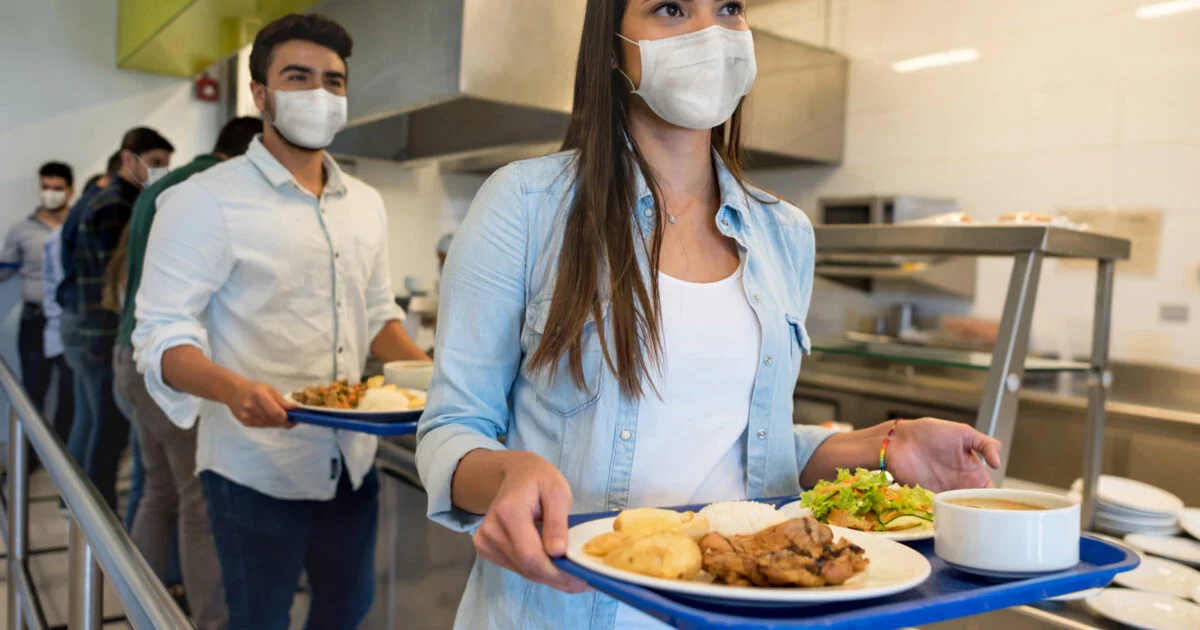


So, lunch at IBM's mensa was a daily ritual, a daily pleasure. Sure, there were days when the menu was more to my liking, but it was really rare to have a day when lunch was a problem. Over the years, I did encounter colleagues who simply reminded me that everything is relative. For them, "mensa", for historical reasons, was almost a given. Some who had already been working for decades would reminisce of a better time when the food was better. Haven't we heard that before now? Occasionally, some would complain about the quality or quantity, but relative to what, I would think? Early on when there was more than one office branch, each had its own mensa, and some colleagues would even occasionally choose to go to a specific branch for lunch simply because in their view it was "better". The grass is greener... goes the saying. For me, avoiding a hotdog or a hamburger (as much as I like them) every day was enough of a difference.
What was it really like, though? What was actually served? The menu, and some days it wasn't actually published, followed Italian eating norms: antipasto, primo, secondo, contorno, dessert. That, in itself, tells you it was a far cry from being served a Sloppy Joe and soggy fries.

Antipasto had the least amount of variety during the week, in part because of the actual demand and the need to ensure reasonable costs to the caterer. Still, a choice between prosciutto crudo and prosciutto cotto isn't shabby. Maybe the prosciutto wasn't a 36-month seasoned Parma or San Daniele, but it certainly was never of poor quality as determined by the grain, the fat, and taste. When in season, it was also available with melon, and it really was quite rare to have a very bland melon rather than a sweet one. Otherwise, mozzarella was always available.
Bread, being Rome, meant rosette, and also Lariano loaf. grissini, or breadsticks, were also available. Since the office also had foreign assignees and people from other countries participating in meetings, the "mensa" also made butter available, although you really had to look for it even if it was just hidden in plain view.
Primo, or first course, had nothing to be shy about. If it was pasta, it could be spaghetti or short pasta. You could have it with a simple tomato sauce any day. Otherwise, the menu would cycle through the standard classics: amatriciana, carbonara, frutti di mare, al salmone, and pesto. By tradition, on Thursdays, you could get gnocchi. With pasta, there was the added challenge of getting it "al dente" the way you wanted it. For how pasta cooks, perfection every day was elusive, but the cooks did a pretty good job considering the amount they made in batches. Only a few people were really picky. The servers, being Italian, were quite happy to do what they could to satisfy people's preferences. So maybe some preferred pasta piping hot, in which case they skipped the first as a sequence and came back later when the new batch arrived. Sometimes it was the desire to have the pasta with a thicker sauce.

Secondo, or second course, by any standard, was outstanding in variety. Actually, it really was in three different forms. The first was a kitchen-prepared dish. A roast was fairly common, but already apportioned rather than a roast to be cut for practical reasons. Turkey-based roast with potatoes was fairly regular with a nice gravy to boot. But turkey can be difficult at times with the bones. If not turkey, then a more traditional chicken roast would be available, with a choice of thigh or breast as a quarter portion. It was probably infinitely better than the most talked about Costco grilled chicken. Seafood was also available, maybe as roast mackerel, calamari, and even swordfish. Not shabby at all. Then there was the grill which was literally made to order. The secret was that a steak was a minute steak and turkey breast was a slice. A pork chop or an Italian sausage took longer to cook but was available from time to time. Your choice if you weren't in a hurry. In later years, meat patty burgers became a common option at the grill, but no buns. French fries became a mainstay but as they were made fresh, there was never enough to make everyone happy, you just had to be lucky in timing. Finally, third, pizza and calzone made to order. There was always a queue. For a cafeteria, like in a restaurant, the preparation for pizza is important to get portions and readiness right. Technically, that's true, but in practice, it isn't enough. It was always a mystery or maybe more like magic, that while the ingredients were the same day to day, amount and source, the same pizza would be quite different in taste simply because there was a different pizzaiolo, or pizza chef, at the helm.

Contorni, or side dishes, were not a forgotten item. The salad was always fresh, and being in Italy, always healthy since the only real condiment available was extra virgin olive oil and balsamic vinegar.

Dessert was perhaps more of a mixed bag as most of the time it was a prepackaged offering - a custard perhaps or a yogurt. At times there was cake, but in very limited quantities, which meant only a fortunate few.
Beverages were simple, non-bottled mineral and plain water were always readily available. Anything was an extra payment, including table wine.

Now, a meal at such a "mensa" wasn't something you would acclaim, but it would give any middle-of-the-road trattoria or restaurant a run for its money. On average, quite acceptable and hardly a time that you would openly say it was terrible. Even a microwave was available should someone want their dish to be warmer or hotter.


An array of fulfilling meals and alway yummy!
Traveling occasionally to other IBM locations around the world, I had the opportunity, or rather the need, to have lunch at the cafeteria where such service existed, and I would be instantly reminded of what was easy to take for granted. Only France had a cafeteria service which was decidedly sophisticated and aimed to provide traditional French menu items. The UK was a real letdown with absolutely awful dishes, offering only a handful of choices, all of which were hardly edible. My solution was to pick up a fresh salmon sandwich from the supermarket at the start of the day and just get a beverage and chips from the cafeteria. The US was perhaps a little more creative, trying to offer some ethnic dishes including Mexican, Indian, and other Asian options, but they mostly resembled something you would find on a flight traveling in economy class. Hamburgers and hotdogs were always available, but relying solely on them for more than a couple of days was really pushing it.

And then an Italian "mensa" offered something else that is perhaps the most unnoticed aspect - eating has always been a convivial moment, and lunch can be one of the most important moments in the working day's balance. Lunch was rarely a short activity; I'd say at least 45 minutes, with an hour being more the average. Table conversation was rarely about work; it mostly veered towards other common areas of interest. Maybe some groups touched on sports or had political discussions, but in all my years, they were not part of my lunches. We covered history, science, philosophy, and of course travel.
Over time, things evolve. A menu is not any different. Covid-19, the ensuing lockdown, and the new normal of office vs. work from home created new challenges for any cafeteria provider. It's hard to keep a viable business if your costs are so variable and quality suffers as a consequence. Changes in people's eating habits as well as what has become fashionable also create changes. I imagine in today's menu a poke bowl wouldn't be unheard of. Still, any cafeteria around the world will still have the country's typical dishes at its core. So, if you get curry and kebab in a London cafeteria, it should not be a surprise. A hamburger and more hamburgers make sense for the US. Unfortunately, the hamburgers are not flame-grilled and maybe more befitting of a prison.
I consider myself lucky that I spent most of my working professional life having some of the best traditional dishes for lunch, never bored by the probable repetition over the months and years. And while, as time passed and tastes changed with younger generation, the classics shared spots with more recent fashionable dishes, it would be unfair for me to really complain as the quality with respect to the rest of the world remain ahead by a long shot. The "mensa" also gave me a wonderful gift that most times was taken for granted - that the lunch break, which is what it was formally, was by custom a shared moment that should be a pause from the focus of work, and a moment to be enjoyed with friendship. It was always a positive moment of any day as life was shared. Sometimes in a group like a family, sometimes in a more personal moment amongst close friends.
Buon appetito!


Comments